Skip to docs navigation

01.05 Bicycle Disassembly Assignment

Throughout the metal fabrication portion of the course, the bicycle will become a platform for learning cutting, welding, tube fitting, joining, mechanical assembly, and metal finishing.

Your goal is not simply to repair, decorate, or customize a bicycle. Think of the bicycle as a collection of useful structures and mechanisms that can be cut apart, rearranged, extended, duplicated, and combined into something unexpected.

The final sculpture does not have to be a vehicle or even remain rideable. It must, however, incorporate bicycle components and include kinetic elements—parts that actually move.

A bicycle already contains many useful mechanisms for creating motion:

  • Wheels and hubs provide large rotating elements with built-in bearings.
  • The headset provides a strong bearing assembly that allows a fork or another structure to rotate.
  • The bottom bracket provides a durable rotating axle that can support cranks, pedals, wheels, arms, or other moving elements.
  • Cranks and pedals can turn continuous rotation into human-powered movement.
  • Chains and sprockets can transmit rotation between different locations.
  • Forks can hold wheels or become rotating structural elements.
  • Rims and tires can act as large pulleys or friction-drive surfaces.

You are encouraged to misuse these mechanisms. A headset does not need to steer a bicycle. A bottom bracket does not need to drive a rear wheel. A wheel does not need to touch the ground. A bicycle rim can become a giant pulley. Belts, rubber, cord, or other flexible materials could transfer motion between wheels. One rotating wheel can also contact another rim or tire and move it through friction, eliminating the need for a conventional bicycle chain.

Think about what happens when one movement causes another movement.

Possible Approaches

  • Stretch, shorten, widen, stack, or radically alter bicycle frames.
  • Combine pieces from multiple bicycles.
  • Use several wheels rotating at different speeds or directions.
  • Transfer motion from one wheel to another with chains, belts, or friction.
  • Use a crank to move an object that normally would not rotate.
  • Turn a wheel horizontally, vertically, diagonally, or overhead.
  • Use the headset as a pivot for an entire sculptural element.
  • Use the bottom bracket and cranks to activate another mechanism.
  • Use wheels, spokes, or cranks to strike, lift, drag, spin, shake, or oscillate another material.
  • Require a viewer to pedal, push, crank, pull, spin, or otherwise activate the work.
  • Become an unconventional human-powered vehicle.
  • Become a stationary kinetic sculpture that no longer resembles a bicycle.

The bicycle is your starting material and mechanical vocabulary, not the required final form.

Bicycle Disassembly

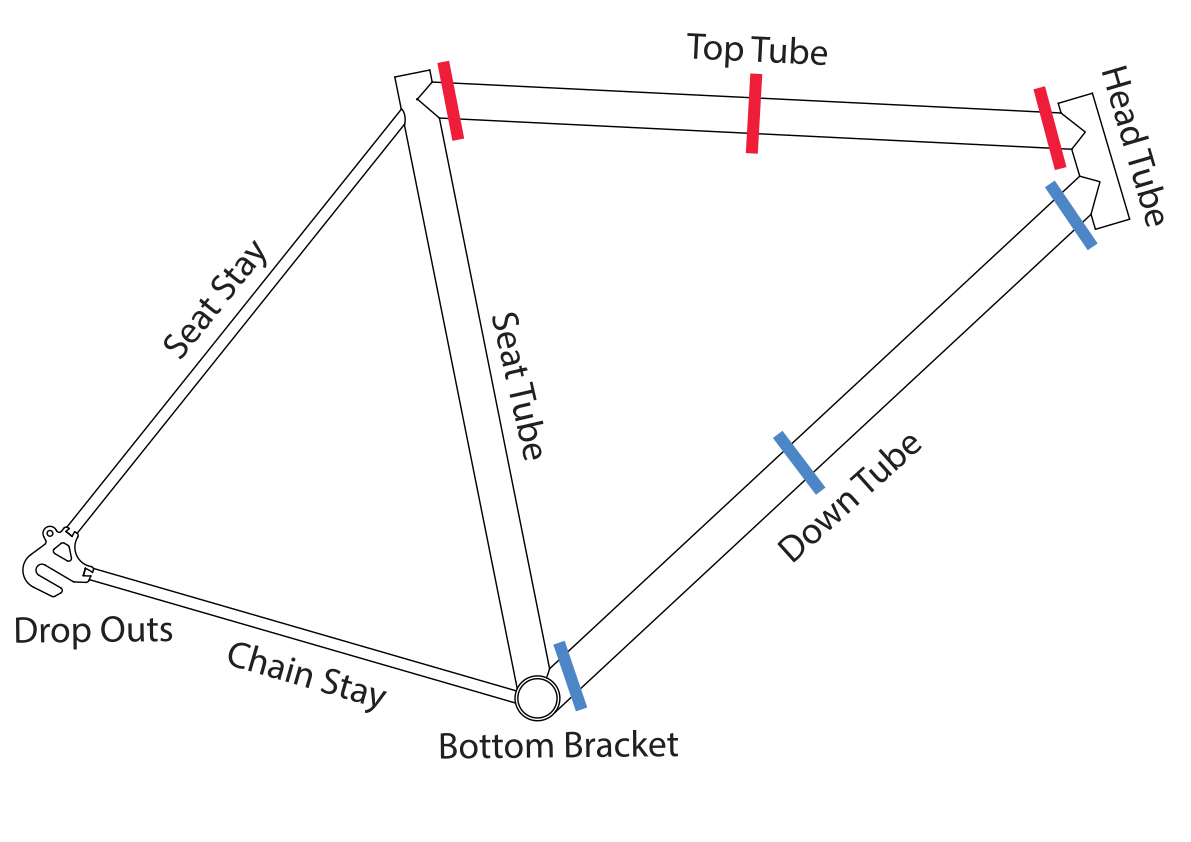
Study the bicycle before cutting anything. Identify components that contain useful mechanical systems and try to preserve them whenever possible.

Pay particular attention to:

  • Headset and head tube
  • Fork
  • Bottom bracket
  • Cranks and pedals
  • Chainrings
  • Chain
  • Rear sprockets or freewheel
  • Wheel hubs
  • Wheels and rims
  • Handlebars and stem
  • Seat and seat post
  • Brake components
  • Frame tubing

Remove reusable components before making destructive cuts. Consider keeping bearing assemblies intact. A functioning headset, bottom bracket, or wheel hub gives you a precise rotational mechanism that would be much more difficult to fabricate from scratch.

Cutting the Bicycle

  1. Decide which portions of the frame may be useful.
  2. Mark planned cuts before cutting.
  3. Secure the frame before using cutting tools.
  4. Make controlled cuts that preserve as much usable tubing as possible.
  5. Save useful offcuts and unusual components.
  6. Deburr sharp cut edges before handling the pieces.

Do not immediately cut everything into small pieces. Larger sections can always be cut smaller later.

Preparing Metal for Fabrication

Remove paint, rust, grease, and other contaminants from areas that will eventually be welded. Use the sandblaster, strip discs, or other demonstrated methods to expose clean steel. You generally do not need to strip the entire bicycle immediately. Concentrate on areas that will be cut, fitted, or welded.

Assignment Deliverables

  1. Ideation Sketches

    • 30–45 minutes of active sketching.
    • Multiple different concepts rather than one finished drawing.
    • Include ideas for kinetic movement and mechanical relationships.
    • Scan or photograph sketches clearly without shadows.
  2. Disassembled Bicycle Components

    • Preserve useful mechanical components including bearings, hubs, cranks, wheels, and other potential moving parts.
  3. Prepared Bicycle Frame / Tubing

    • Make controlled cuts as needed for experimentation.
    • Deburr sharp edges.
    • Remove coatings from areas that will later be welded.

The bicycle you begin with is only the starting point. Over the next several weeks, it will become both raw material and a mechanical toolkit through which you learn the fundamentals of metal fabrication.

Artist + Project References

These references approach bicycles in very different ways. Some retain the bicycle as a human-powered machine, while others use bicycle wheels, bearings, chains, frames, or other components as raw material for kinetic sculpture.

  1. Koichiro Azuma — especially relevant for large interactive sculptures constructed from discarded bicycles and fabricated steel. Koichiro Azuma — Worksexternal link
  2. Jean Tinguely — kinetic machines built from wheels, belts, motors, scrap metal, and found mechanisms. Museum Tinguely — Jean Tinguelyexternal link
  3. Marcel Duchamp — Bicycle Wheel demonstrates the bicycle wheel as both found object and freely rotating sculpture. MoMA — Bicycle Wheelexternal link
  4. Ai Weiwei — uses repeated bicycle forms to transform a familiar functional object into large-scale sculpture and installation. Hirshhorn — Forever Bicyclesexternal link
  5. Diane Landry — motorized installations incorporating bicycle wheels, pulleys, timing belts, bearings, light, and other materials. Diane Landry — Knight of Infinite Resignationexternal link
  6. Nemo Gould — kinetic found-object machines useful for studying mechanisms, cranks, linkages, and imaginative reuse. Nemo Gould — Kinetic Sculptureexternal link
  7. Mark Grieve — co-creator of Cyclisk, a monumental sculpture made from hundreds of discarded bicycles. Cyclisk Public Art Projectexternal link
  8. Ilana Spector — co-creator and fabricator of Cyclisk. Cyclisk Public Art Projectexternal link
  9. Cyclecide — artist collective transforming junk bicycles into tall bikes, unusual vehicles, kinetic sculptures, and pedal-powered carnival rides. Cyclecide Bike Rodeoexternal link
  10. Chris Cole — kinetic sculptor who transforms salvaged bicycle and mechanical parts into moving creatures and machines. Chris Cole Designsexternal link
  11. Juan Martinez — articulated, rideable animal sculptures fabricated from bicycle components and metal. Juan Martinez — Sculpture Magazineexternal link
  12. Melissa Daubert — interactive kinetic sculpture incorporating bicycle parts, cranks, wheels, and audience activation. Melissa Daubertexternal link
  13. Alex Rodriguez / Dr. ARod — kinetic sculptures using bicycle wheels and components as rotating systems. Dr. ARod’s Artexternal link
  14. Patricia Vader — kinetic and public sculptures incorporating bicycle wheels and hubs. Patricia Vader — RAexternal link
  15. Jake Beckman — RotaFlora, a 34-foot sculpture fabricated from bicycle wheels. RotaFlora — Ohio Outdoor Sculptureexternal link
  16. Cindy Chinn — sculptures made from recycled bicycle tires, wheels, pedals, and other components, including kinetic works activated by pedals. Cindy Chinn — Re-Tired Artworkexternal link
  17. Rachel Dorn — combines discarded bicycle components with ceramic and mixed-media sculpture. Rachel Dorn — Bicycle Parts Sculptureexternal link
  18. Keith Bryant — combines bicycle components, sprockets, wood, glass, and found objects into mixed-media sculpture. Keith Bryant — Machinations of Sprockets and Woodexternal link
  19. Daria Wendland — large installations constructed from salvaged bicycle wheels. Daria Wendland — Abgefahrenexternal link
  20. Norman Tuck — interactive kinetic sculpture using bicycle wheels, motors, chains, and deceptively simple mechanical systems. Norman Tuck — Lariat Chainexternal link

When looking at these references, do not concentrate only on what the finished sculpture looks like. Look at how motion is produced and transferred: wheels, axles, bearings, belts, chains, pulleys, cranks, friction, gravity, motors, and the body can all become sculptural materials.